
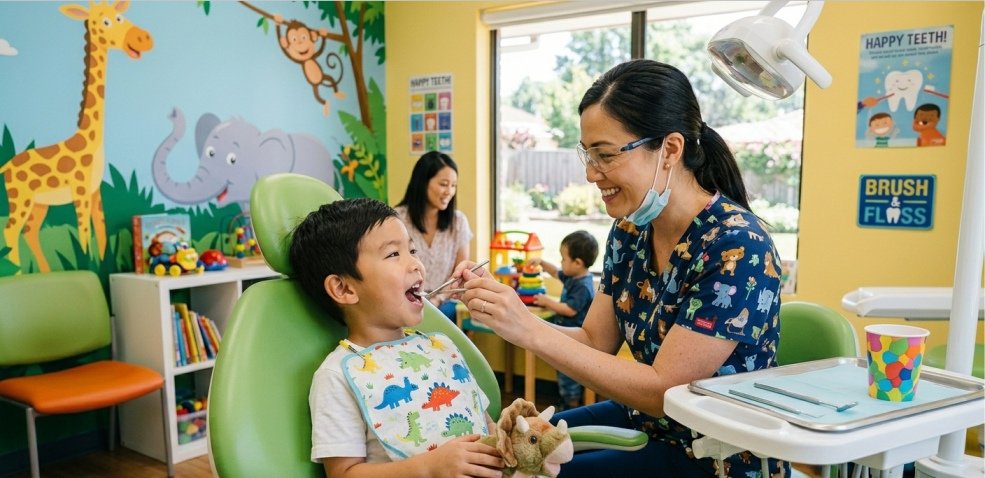
Becoming a paediatric dentist in Malaysia requires a rigorous 11 to 13-year journey. This includes a five-year foundational dental degree, one year as a house officer, two to three years of compulsory government service, and a three to four-year full-time Master’s programme focused on child psychology, sedation, and managing medically compromised children.
When you take your child to the clinic for a check-up, you naturally want the highest standard of care possible. Choosing a qualified pediatric dentist ensures your little one receives treatment from an expert specifically trained in childhood oral health. Most parents only see the colourful clinic walls, the toys in the waiting room, and the friendly doctor handing out stickers at the end of an appointment. The reality behind that cheerful demeanour is a highly demanding, decade-long clinical marathon.
Building trust with a healthcare provider requires transparency. Understanding the sheer volume of education and hands-on experience a paediatric dentist accumulates helps parents appreciate the level of expertise available to their children. This 12-year journey transforms a basic dental student into a highly specialised expert capable of managing the most challenging pediatric cases.
What is the foundational training for dentists in Malaysia?
The journey to becoming a paediatric dental specialist starts with the same foundational training required for any licensed dentist in the country. This initial phase builds the core medical and dental knowledge necessary for all future specialisations.
Five years to complete a Doctor of Dental Surgery (DDS) or Doctor of Dental Medicine (DMD)
Every aspiring dentist must first complete a five-year undergraduate degree. During this time, students study human anatomy, physiology, pathology, and pharmacology. They spend thousands of hours in simulation labs and university clinics learning how to diagnose oral diseases, perform extractions, and restore damaged teeth.
One year working as a house officer
After graduating with a DDS or DMD, the new dentist enters a mandatory one-year house officer programme. During this period, the junior doctor rotates through various hospital and clinic departments. They gain exposure to oral surgery, periodontics, and general dentistry under the strict supervision of senior specialists.
What happens during compulsory government service?
Before a dentist can apply for a highly competitive Master’s programme to specialise, they must serve the Malaysian public.
Two to three years of public health and rural service
The Ministry of Health requires dental officers to complete two to three years of compulsory government service. Many dentists are posted to rural or semi-urban clinics across Malaysia. This crucial period forces young practitioners to manage high patient volumes, handle limited resources, and treat a wide demographic of patients. They encounter severe dental trauma and advanced decay, building immense clinical confidence and resilience.
How does a general dentist specialise in paediatric dentistry?
Once the compulsory service is complete, a dentist can apply to specialise. Acceptance into a paediatric dentistry Master’s programme is exceptionally competitive, with universities only accepting a handful of candidates each year.
Three to four years of a full-time Master’s programme
The Master’s programme demands three to four years of full-time, intensive clinical training. A postgraduate resident focuses entirely on children, from infants to adolescents. They learn advanced techniques for saving primary teeth, interceptive orthodontics, and complex surgical extractions.
Two to three years of thesis research on child psychology and sedation
Technical dental skills are only one part of the equation. Children are not simply small adults; they require highly specific behavioural management techniques. Throughout the Master’s programme, residents conduct two to three years of concurrent thesis research. They study child psychology, non-pharmacological behaviour management, and conscious sedation techniques. This ensures they can safely treat highly anxious children or those with neurodivergent conditions like autism spectrum disorder.
Weekly on-call training for paediatric dental emergencies
Accidents happen constantly in childhood. Postgraduate residents undertake weekly on-call shifts at major hospitals to manage severe paediatric dental emergencies. They treat toddlers who have fallen and knocked out teeth, adolescents with sports-related jaw fractures, and severe facial infections that require immediate surgical intervention.
Why do children with severe medical conditions need paediatric dentists?
A general practitioner is perfectly equipped to handle routine fillings and cleanings for a healthy adult. However, treating a medically compromised child carries significant risks that require a specialist’s intervention.
Paediatric dentists are heavily trained to treat children with complex underlying health issues. For example, a child undergoing chemotherapy for cancer requires precise dental management to prevent life-threatening oral infections. Children with congenital heart conditions face a high risk of bacterial endocarditis during routine dental procedures, requiring strict antibiotic protocols. Similarly, patients with bleeding disorders like haemophilia need specialized surgical techniques to prevent excessive blood loss during extractions. General dentists routinely refer these high-risk cases to paediatric specialists because the specialists possess the hospital training required to manage severe medical complications.
Choosing the Right Care for Your Child’s Smile
The 12-year pathway to becoming a paediatric dentist in Malaysia is gruelling. It requires immense personal sacrifice, endless examinations, and thousands of hours of clinical practice. For parents, understanding this timeline provides peace of mind. When you sit in the specialist’s chair, you are benefiting from over a decade of dedicated, child-focused medical training.
If your child has high dental anxiety, complex medical needs, or simply requires a gentler approach to oral health, seeking out a qualified paediatric dentist is the safest and most effective choice you can make.
Frequently Asked Questions (FAQ)
What is the difference between a general dentist and a paediatric dentist?
A general dentist completes a five-year degree and treats patients of all ages. A paediatric dentist completes that same five-year degree, plus an additional three to four years of full-time specialist training focused entirely on children, child psychology, special needs care, and advanced sedation techniques.
When should a child first visit a paediatric dentist?
The Malaysian Dental Association and international paediatric dental guidelines recommend that a child visits a paediatric dentist by their first birthday, or within six months of their first tooth erupting. Early visits help prevent early childhood caries and establish a positive relationship with the dentist.
Does my child need to see a paediatric dentist for a routine check-up?
Choose a paediatric dentist if your child experiences severe dental anxiety, has a diagnosed medical condition, or has special educational needs. If your child is healthy, highly cooperative, and only requires a basic check-up, a family general dentist is usually sufficient.
What sedation options do paediatric dentists offer in Malaysia?
Paediatric dentists in Malaysia typically offer nitrous oxide (laughing gas) for mild to moderate anxiety, oral conscious sedation, and full general anaesthesia administered in a hospital setting for complex surgeries or highly uncooperative young children.